Introduction
Getting ready for WAEC, NECO or JAMB can be really tough. You have a lot of subjects to study and not a lot of time before the exam. Some students start out strong. Then they do not have a plan. They just Read without knowing what to do next. Some students skip the subjects or try to study everything at the last minute.
Having a study schedule helps you stay on track. It shows you what to study every day. You do not have to think about what to do. You can just focus on doing a bit of work each day. This way you can cover all the subjects. Have time to review before the exam.
The good thing is that making a study schedule is not hard to do. If you are getting ready for WAEC, NECO or JAMB you can follow some steps. You need to know how much time you have. You need to decide which subjects are most important. You need to study a bit every day. You need to review what you have already learned.
In this guide you will learn how to make a study schedule that works for you. It will help you stay on track and do well on your exams. If you do not want to make a schedule by yourself you can use our free study planner to make one, in a few minutes.
Why You Need a Study Timetable
A study timetable is a plan that helps you use your time in a way and stay focused on your exam goals. Whether you are preparing for WAEC, NECO or JAMB having a study timetable can make your study sessions more productive and less stressful.
It helps you cover the syllabus
If you do not have a plan you might spend too much time on the subjects you like and not enough time on the other subjects. A study timetable makes sure every subject gets the attention it needs before your exam. This way you can cover the syllabus for WAEC, NECO or JAMB.
It reduces last minute cramming
Many students leave topics until the last few days before an exam. By spreading your study sessions over weeks or months you can learn at a pace and avoid the pressure of trying to memorize everything at once for WAEC, NECO or JAMB.
It keeps you consistent
Studying for few hours every week is usually better than trying to study all day once in a while. A study timetable helps you build a routine making it easier to stay disciplined and keep making progress with your study timetable.
It gives you time to revise
Reading a topic once is rarely enough. A good study timetable includes time to go back and review what you have already studied for WAEC, NECO or JAMB helping you remember information for longer and feel more confident on exam day.
The best study timetable is one you can really follow. It should fit your time your subjects and your current level of preparation, for WAEC, NECO or JAMB. Not someone elses schedule.
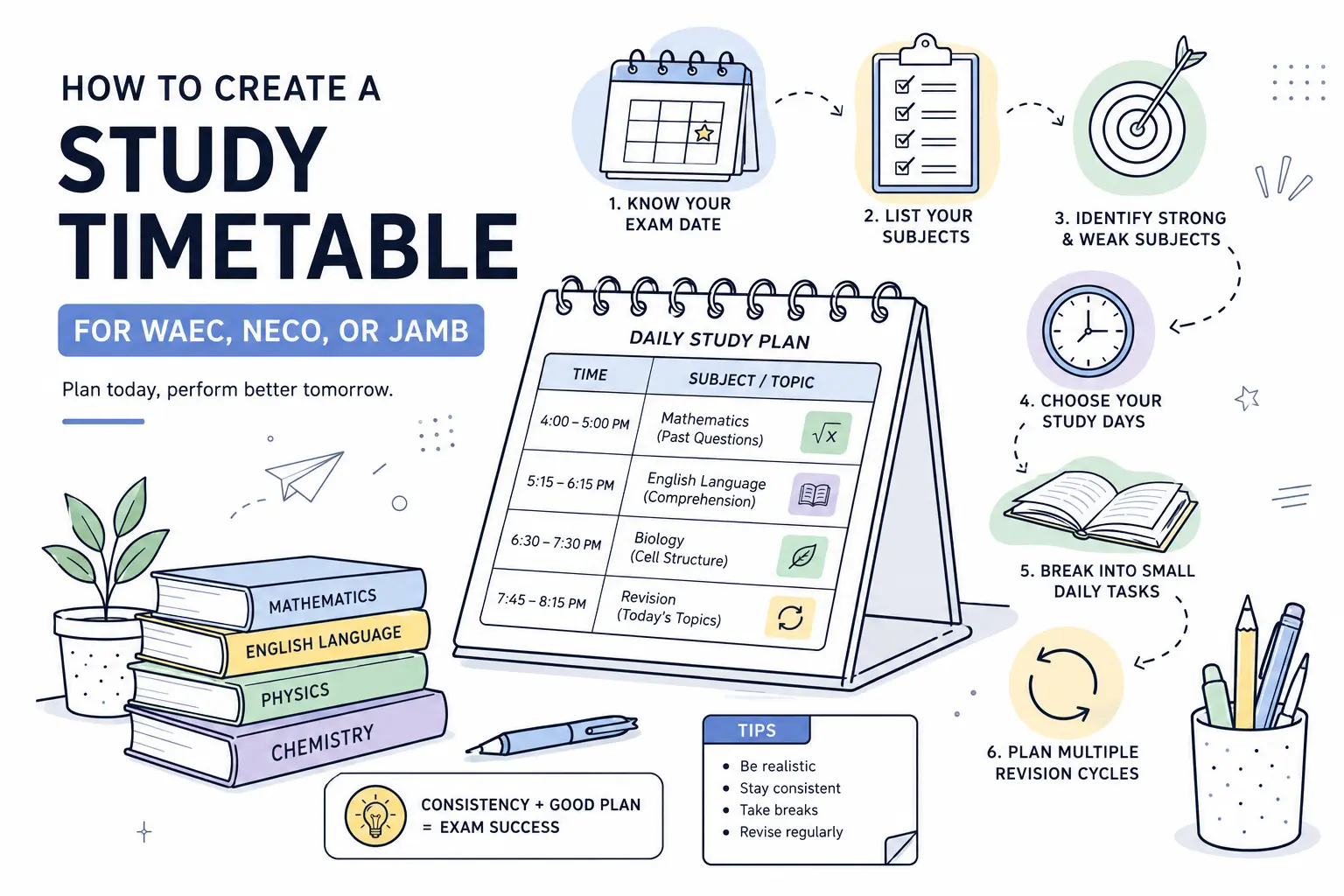
How to Create Your Study Timetable
Creating a study timetable is easier than you might think. Follow these simple steps to build a plan that works for your schedule.
1. Know your exam date
Start by finding out how many days you have until your WAEC, NECO, or JAMB exam. The more time you have, the more evenly you can spread your study sessions and revision.
2. List all your subjects
Write down every subject you'll be taking. Seeing everything in one place makes it easier to divide your time fairly and ensures no subject is forgotten.
3. Identify your weak subjects
Be honest with yourself. If you're struggling with Mathematics or Physics, they should appear in your timetable more often than subjects you're already confident in.
4. Choose the days you can study
Don't force yourself to study every day if you know you won't. Pick the days you're most likely to stay committed. A timetable you follow is better than a perfect one you abandon.
5. Break your work into small tasks
Instead of writing "Study Biology," be specific. Write tasks like "Read Cell Structure (pages 15–28)" or "Solve 20 Mathematics past questions." Small tasks are easier to complete and keep you motivated.
6. Make time for revision
Reading a topic once isn't enough. Go back and review what you've studied regularly so you remember it when the exam arrives.
By following these steps, you'll have a timetable that's realistic, organized, and much easier to stick to.
Example Study Timetable
Here's a simple example of what a daily study timetable might look like. Your own timetable will depend on your subjects, available time, and exam date.
| Time | Task |
|---|---|
| Jan 1st | Mathematics: Solve 20 past questions |
| Jan 2nd | English: Read Comprehension and Vocabulary |
| Jan 3rd | Break |
| Jan 4th | Biology: Cell Structure (Pages 15–28) |
| Jan 5th | Revise today's topics |
Notice that each study session has a clear goal instead of a vague task like "Read Mathematics." Breaking your work into smaller tasks makes it easier to stay focused, measure your progress, and complete your daily goals.
You don't need to study for long hours every day. A timetable that you can follow consistently is far more effective than one that's too demanding to maintain.
Create Your Study Timetable in Minutes
Making a study schedule on paper takes time. You need to figure out how many days are left until your exam split up your subjects plan review times and ensure your work is spread out evenly.
With Osioplan, you can generate a personalized study timetable in just a few minutes.

Simply:
-
Select your exam (WAEC, NECO, or JAMB).
-
Choose your subjects and topics.
-
Enter your exam date.
-
Pick the days you want to study.
-
Choose how many times you want to revise your syllabus.
Osioplan makes a study plan that fits your schedule. You can also keep track of your daily tasks, mark completed sessions, and stay organized throughout your exam preparation.
Whether you're starting months before your exam or catching up with only a few weeks left, having a clear study plan can help you make the most of the time you have.
Start planning today and let Osioplan build your study timetable for free.
Frequently Asked Questions
How many hours should I study each day?
The number of hours I should study each day is not set in stone. You can get by with two to four hours of study each day if you do it every day and stick to a schedule that works for you.
Should I study every day?
You do not have to study every day. It is better for you to pick the days when you know you will be able to study and stick to those days. Studying four or five days a week is better than trying to study every day and then giving up after one week.
How many subjects should I study in one day?
For most students, studying two or three subjects a day is enough. This helps you stay focused without feeling overwhelmed.
How often should I revise?
Try to revise regularly instead of waiting until the last week before your exam. Reviewing what you've already learned helps you remember it better and identify topics that need more attention.
Can I use Osioplan for free?
Yes. Osioplan is completely free to use. Simply enter your exam details, and it will generate a personalized study timetable based on your schedule.
Conclusion
A good study timetable doesn't have to be complicated. The key is to create a plan that's realistic, consistent, and gives you enough time to cover every subject and revise before your exam.
If you're preparing for WAEC, NECO, or JAMB, don't wait until the last minute to organize your studies. Start with a clear plan, stick to it, and make studying a daily habit.
If you'd rather skip the manual planning, Osioplan can generate a personalized study timetable for you in minutes. It's free, easy to use, and designed to help Nigerian students stay organized and prepare with confidence.